
Echoencephalograph (EEG) Compact Neuro 21 channels
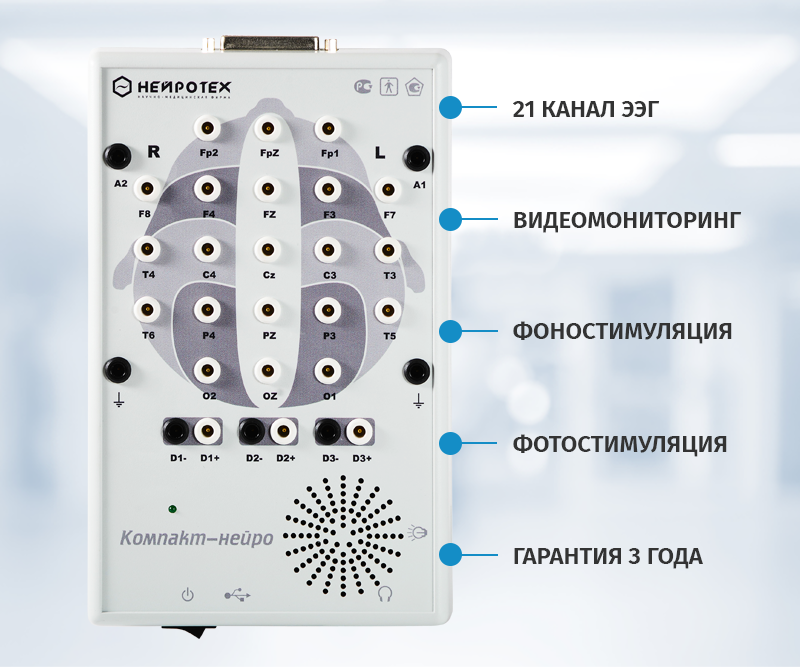
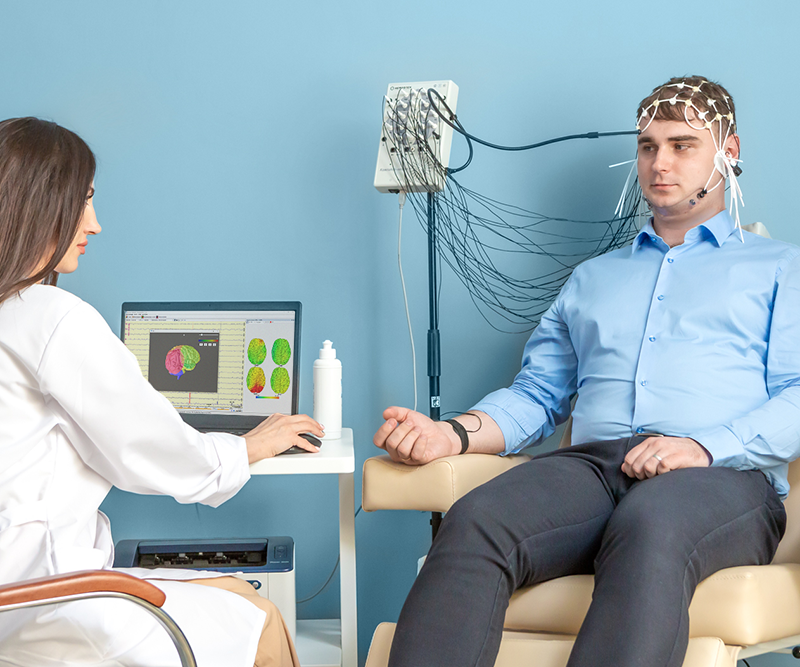
Echoencephalograph (EEG) Compact Neuro 21 channels
Get a Quote
Electroencephalograph (encephalograph) "Compact Neuro" (21 channel) is intended for conducting routine (according to generally accepted methods) and in-depth studies of the bioelectric activity of the brain, both according to arbitrarily selected (built-in) standard examination protocols, and according to protocols created by the user independently (with taking into account flexible configuration of the necessary protocol parameters). The main purpose of the system is the diagnosis of epileptic changes in the EEG, registration of EEG during sleep and dynamic assessment of the functional activity of the brain. Recording is made using any number (up to 21) of standard electroencephalographic leads in monopolar or bipolar mode with the possibility of parallel recording of the patient’s video image using a web camera.
System and software capabilities
Main types of mathematical analysis and EEG processing:
• automated search for areas of pathological epileptic activity, including for long-term recordings;
• automatic search and selection of artifacts on the EEG signal;
• spectral analysis;
• correlation analysis;
• topographic 2D and 3D mapping in real time;
• calculation of interhemispheric asymmetry, index and frequency of rhythms.
Main functions of the software:
• quality control of electrode application by interelectrode resistance in real time (impedance measurement function);
• automatic description of functional tests in the report, automated generation of a report in text and tabular form;
• availability of a database of preset electrode application patterns (monopolar and bipolar) and the ability to create your own (custom) patterns using the built-in electrode application pattern editor;
• the ability to print the necessary sections of the EEG signal in accordance with the established parameters (printing time interval, printing provocative tests, printing the active screen with the signal and the entire registered EEG signal);
• EEG registration according to pre-formed (preset) protocols and the ability to create custom protocols with the required number and parameters of provocative tests, including for phonostimulation and photostimulation (stimulus frequency, power, impulse, duration of conduction, pauses, etc.);
• recording of the EEG signal according to the protocol and without the protocol, the ability to change the sequence of provocative tests within the protocol;
• the ability to add events, EPI activity zones, artifacts, text notes, samples to the recorded signal both in the EEG signal recording mode and after its completion;
• the possibility of parallel video recording during the examination (using two or more cameras);
• the ability to select (and switch) bipolar schemes both during the examination (in real time) and upon its completion;
• application of digital filters both in real time and after completion of signal recording, filtering network interference;
• the presence of bandpass filters to highlight frequency ranges;
• switching signal display scales – by time (sweep) and amplitude (sensitivity), filter parameters both in real time and after recording the EEG signal;
• built-in database of standard templates and phrases for filling out the fields of the reporting form (predefined templates for drawing up conclusions), the ability to add, save, edit and delete your own templates and phrases.
Database functionality:
• a convenient and intuitive database interface allows you to quickly fill in information about the patient during their registration in the electronic file cabinet;
• mechanisms for sorting the list of patients by criteria (by alphabetical order, gender, age, date of registration and date of last examination) and quick search of a patient from the list using several letters of their full name;
• ample opportunities for remote and remote description of surveys via cloud storage or a network drive: completed surveys are automatically uploaded to any convenient cloud service, which provides the ability to access surveys from anywhere in the world;
• the ability to export the reporting form to Microsoft Office Word and PDF;
• export to Loreta program;
• the ability to record a portable version of a patient’s examination on a disk and/or flash card, to view which (on another PC) does not require the installation of specialized software;
• import/export of performed EEG examinations;
• EEG examination can be exported to CSV, EDF, EDF+ formats and processed using well-known international programs: LORETA, EEGLAB, BESA, CURRY, etc.;
• high level of security of stored data – encryption of survey results, backup and restoration of the database from a backup copy;
• the ability to create databases individually for each user (specialist).
Installation and Training InformationInstallation and training of specialists are included in the equipment cost
Free WarrantyWithin 12 months from the date of equipment delivery
Post-warranty ServicePost-warranty technical maintenance on a contractual basis for the entire period of operation